Diagnostic Test
TESTING FOR VOLTAGE DROP
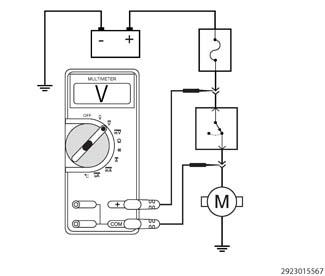
- Turn the ignition off.
- Use the wiring diagram as a guide, trace the circuit being tested and locate the components related to the circuit.
- Set the multimeter to measure DC voltage.
- Carefully back probe the two component harness connectors of the circuit being tested.WARNING:
When the engine is operating, do not stand in direct line with the fan. Do not put your hands near the pulleys, belts or fan. Do not wear loose clothing. Failure to follow these instructions may result in possible serious or fatal injury.
NOTE:If you are testing the starting circuit, disable the engine so the engine does not start.
- Crank the engine for five seconds if you are testing the starting circuit and monitor the multimeter voltage reading.
- For circuits that don't require the engine running, turn the ignition on.
- For circuits that require the engine running, start the engine.NOTE:
If the circuit you are checking needs to be operating, such as the Blower Motor or a Lamp, do so now.
- Monitor the voltage reading.
- The voltmeter will show the difference in voltage between the two points.
Is the voltage less than 0.2 of a Volt?
Yes
- At this time the circuit is functioning properly. Continue to measure the voltage between the components and wiggle the wire harness and connectors while checking for an intermittent condition.
- Use the wiring diagram as a guide to trace the circuits and look for any in-line connectors where the excessive resistance could occur intermittently.
- Look for any chafed, pierced, pinched, or partially broken wires.
- Look for broken, bent, pushed out or corroded terminals. Verify that there is good pin to terminal contact in the related wire harness connectors.
- Perform any Technical Service Bulletins (TSBs) that may apply.
No
- Repair the excessive resistance in the circuit.
- Use the wiring diagram as a guide to trace the circuit and look for any in-line connectors where the excessive resistance may occur.
- Look for any chafed, pierced, pinched, or partially broken wires.
- Look for broken, bent, pushed out or corroded terminals. Verify that there is good pin to terminal contact in the related wire harness connectors.
- Perform any Technical Service Bulletins (TSBs) that may apply.